
When planning a commercial or industrial building, choosing the right building envelope is a critical choice that affects construction schedules, labor requirements, long-term operating costs, energy efficiency, and the overall performance of the finished building.
For decades, traditional wall assemblies have been the standard approach. Today, insulated metal building panels provide an alternative that combines insulation, weather protection, and finished interior and exterior surfaces into a single engineered system. While both approaches can produce durable, high-performing buildings, they differ significantly in how they're constructed and how they perform over the life of the building.
Understanding those differences can help owners, architects, engineers, and contractors make a more informed decision.
Insulated metal building panels are factory-manufactured building envelope systems consisting of two steel facings permanently bonded to a rigid insulating foam core. Unlike traditional wall assemblies that require multiple layers to be installed individually, insulated metal panels combine several building envelope functions into one prefabricated product.
These metal building insulated panels provide thermal insulation, weather protection, and finished interior and exterior surfaces within a single system. Because the panels arrive ready for installation, they can simplify construction while supporting consistent quality and long-term building performance.
FALK manufactures insulated metal building panels for commercial, industrial, mission critical, modular construction, agricultural, food processing, cold storage, and distribution facilities where durability, thermal performance, and construction efficiency are important priorities.
Although both systems are capable of creating durable buildings, they approach construction very differently.
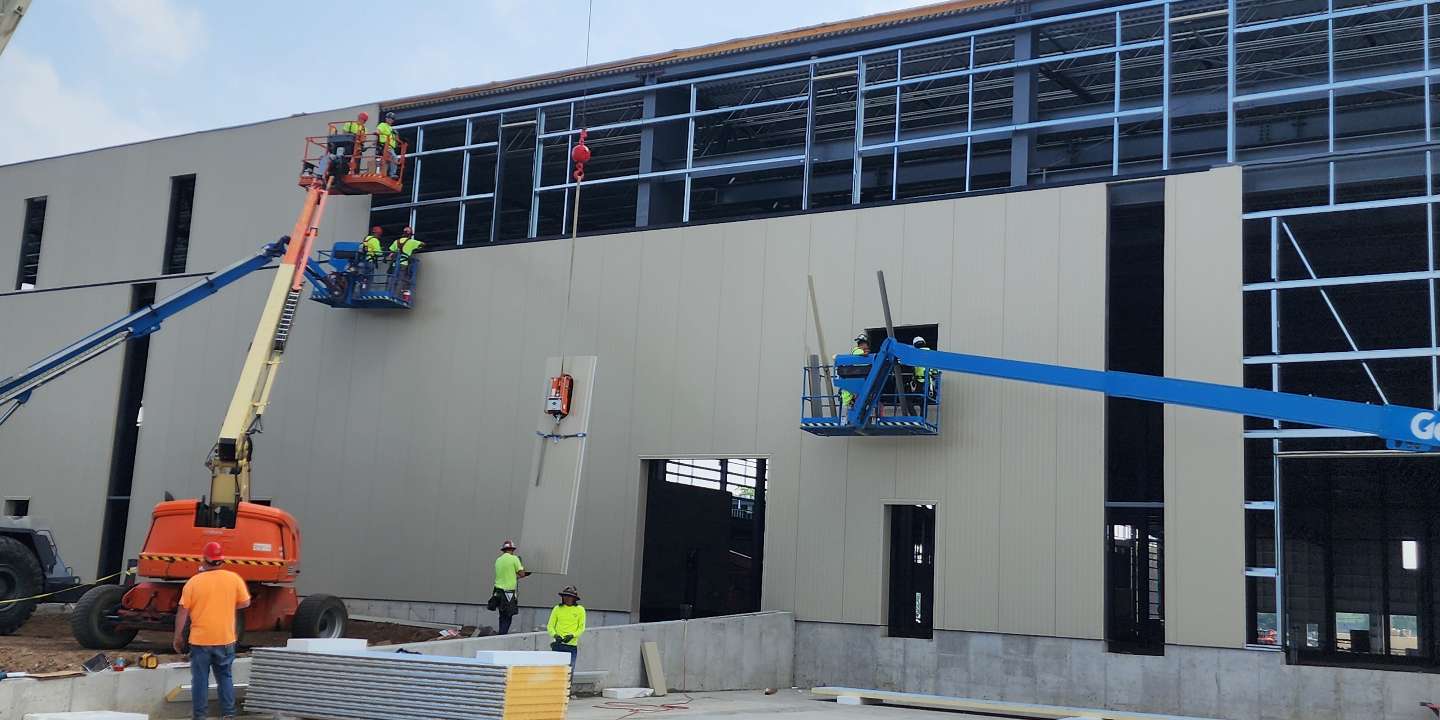
Traditional wall assemblies require multiple products to be installed in sequence. Structural framing is followed by sheathing, insulation, air and vapor barriers, exterior cladding, and often a separate interior finish. Each stage typically involves different materials and multiple trades working according to a carefully coordinated schedule.
Insulated metal building panels simplify that process by integrating many of these components into one factory-manufactured system.
|
CONSIDERATION |
TRADITIONAL BUILDING MATERIALS |
INSULATED METAL BUILDING PANELS |
|---|---|---|
|
Building Envelope |
Multiple separate components |
Integrated panel system |
|
Installation |
Several installation stages |
One installation stage, requiring only one pass around the building |
|
Insulation |
Installed separately |
Factory-integrated insulation core |
|
Air & Moisture Control |
Separate barrier systems |
Integrated panel assembly |
|
Exterior Finish |
Installed after wall assembly |
Factory-finished steel with quality, durable coatings |
|
Construction Schedule |
Multiple trades working in sequence |
Faster building enclosure |
The result is a building envelope that requires fewer installation steps while maintaining the thermal performance and durability required for demanding commercial and industrial applications.
One of the biggest misconceptions when comparing building systems is that the lowest material cost automatically produces the lowest project cost.
In reality, the building envelope influences much more than the purchase price of individual materials.
Labor availability, project scheduling, equipment costs, weather delays, and trade coordination all contribute to the total installed cost of a building. Traditional wall assemblies often require multiple crews to complete successive phases of construction, with each stage depending on the previous one being completed correctly.
Because insulated metal panels arrive ready for installation, builders can often enclose the structure more quickly. Reaching a weather-tight building sooner may allow interior trades to begin earlier, helping projects maintain construction schedules and reducing overall labor requirements.
While every project is unique, evaluating only the initial material cost rarely provides an accurate picture of total project value.
Construction costs are only part of the equation. A commercial or industrial building may remain in service for several decades, making long-term performance equally important.
Thermal performance plays a significant role in operating costs throughout the life of the building. Because insulated metal panels are manufactured with a continuous insulation core, they can provide consistent thermal performance across the building envelope when properly designed and installed. This can help reduce energy loss while supporting occupant comfort and building efficiency.
Durability is another important consideration. The steel facings used in insulated metal panels are designed to withstand demanding environmental conditions while requiring relatively little maintenance. Since the insulation and finished surfaces are integrated into one engineered product, there are fewer individual building components that may require inspection, repair, or replacement over time.
For owners evaluating lifecycle costs rather than simple construction costs, these long-term performance characteristics often become an important part of the return-on-investment calculation.
Insulated metal panel buildings are used throughout commercial and industrial construction because they combine thermal performance, weather protection, and architectural flexibility in a single building envelope system.
They are commonly specified for manufacturing facilities, warehouses, distribution centers, mission critical facilities, food processing plants, cold storage buildings, agricultural operations, aviation facilities, commercial developments, and modular construction projects. In each of these environments, building owners often value shorter construction schedules, reliable thermal performance, and durable exterior finishes that continue performing for many years.
Modern metal building insulated wall panels are also available in numerous colors, profiles, finishes, and thicknesses, allowing architects to satisfy both performance requirements and aesthetic objectives.
Return on investment is influenced by much more than construction cost.
Building systems that improve energy efficiency, reduce maintenance, accelerate construction, and deliver lasting performance can create significant value throughout the life of the facility.
When evaluating insulated panels for metal buildings, many owners consider questions such as:
Looking at these factors together provides a much more complete picture of overall value than comparing material costs alone.
Selecting the right building envelope depends on the specific goals and requirements of each project.
Insulated metal building panels have become an increasingly popular choice for commercial and industrial construction because they simplify installation while delivering strong thermal performance, long-term durability, and architectural flexibility. For projects where construction schedules, lifecycle costs, and energy efficiency are major considerations, they can offer significant advantages over conventional wall assemblies.
Selecting the right building envelope ultimately depends on your project's goals, budget, climate, building use, and long-term operating objectives.
Every building project has unique performance requirements. Whether you're designing a manufacturing facility, warehouse, cold storage building, mission critical facility, agricultural operation, or commercial development, choosing the right building envelope is an investment in the future performance of your facility.
FALK manufactures insulated metal building panels engineered to simplify construction while delivering outstanding thermal performance, durability, and architectural flexibility. Contact our team to discuss the right insulated metal panel solution for your next project.
The purchase price of insulated metal building panels may differ from traditional materials, but total project cost also includes labor, construction time, equipment, and trade coordination. Evaluating the complete installed cost often provides a more accurate comparison.
Insulated metal panels for metal buildings consist of two steel facings permanently bonded to a rigid insulating foam core. The finished panel combines insulation, weather protection, and finished surfaces into a single engineered building product.
Insulated metal panel buildings are widely used for manufacturing facilities, warehouses, food processing plants, cold storage, mission critical facilities, agricultural buildings, commercial developments, and distribution centers where energy efficiency and durability are important.
Yes. Properly designed and installed metal building insulated wall panels provide continuous insulation and excellent thermal performance, helping reduce energy loss while supporting long-term building efficiency.
My Request
Enter your name and email address to receive unlimited access and unrestricted downloads.


 United Kingdom
 Français
 Nederland
 Ireland
 US
US
 Deutschland
 Canada